Novelty acts today, but investment surging • The Register


By the time the humanoid robots arrived at the Humanoids Summit at the Computer History Museum in Mountain View, California, on December 11, the registration line had already extended downstairs to the lobby.
Controlled by accompanying human handlers, the humanoids were herded into the elevator, sparing them the challenge of climbing the stairs to the mezzanine registration desk.
“No one shows you climbing stairs when it comes to these humanoids,” observed Abhinav Gupta, co-founder of Skild AI, during a presentation later that morning.
Gupta did, though, in a video demonstrating how the Skild foundation model can help a robot to climb stairs and step over unstable terrain.
Humanoids Summit chair and founder Modar Alaoui, general partner at ALM Ventures, a VC firm backing several attending companies, would later remark, “Locomotion is a solved problem.”
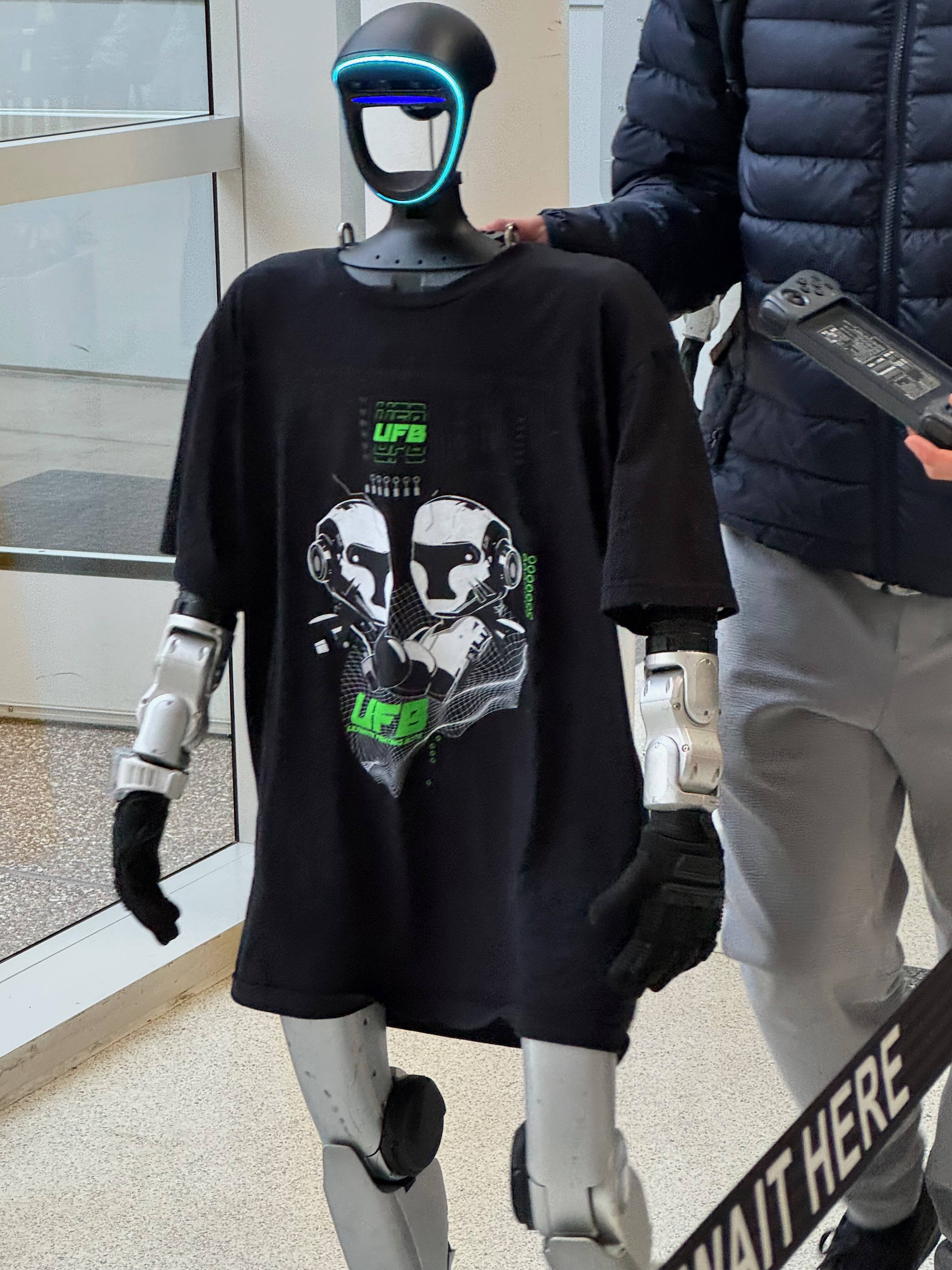
Image of a humanoid robot arriving at the Humanoids Summit – Click to enlarge
That’s a slight exaggeration. Humanoid robots are ready for marketing and experimentation. In promotional videos, they perform impressive, potentially useful feats. But commercial deployment at scale will take decades, even if persistent technical challenges like manual dexterity may be solved sooner.
The technology isn’t yet good enough, the cost remains too high, and organizations need to figure out how to use them. More work needs to be done on safety, and people aren’t yet ready to accept them.
Gupta followed a presentation by Ani Kelkar and Mikael Robertson, partner and senior partner respectively at McKinsey & Company, a corporate consultancy known for advocating staff cuts that itself has been trimming staff due to AI.
Speaking from a management perspective, Robertson said, “Looking at the US as an example, only about 6 percent of factories today have applied robotic automation at scale … And by comparison, China today is installing 10 times more robots each year than the US.”
Robertson said that interest and investment in humanoid robotics have surged.
Kelkar said there are about 50 companies credibly doing so – about 20 in China, 15 in North America, 7 in EMEA, and 7 in Asia (outside of China).
“With all of that talent and all of the investments that Mikael talked about, we are excited that we are finally going to get solutions that will work,” said Kelkar.
Not immediately though. Beyond the difficulty of deploying any sort of robot at scale, Kelkar suggested the viability of robots may depend on human labor management.
“So in a warehousing context, if you have a turnover rate at 40 percent, you take one or two months, you hire someone, you train them up, and five months later, that cycle repeats,” he explained. “And that becomes a significant drag on industrial productivity.
“And I think fundamentally leaders are recognizing that the reason to leverage robotics and automation is not for worker replacement, it’s for redesigning the nature of work. It’s to enhance the work that human labor does, and bring robots even as tools and teammates, not necessarily a job displacement member.”
Pitching a human-robot detente appears to be advisable because humans represent one of several obstacles that humanoid robot makers need to consider.
During a panel discussion led by Washington Post reporter Gerrit de Vynck, Jeff Pittelkow, managing director for Roboworx, a robot management service, said that robot customers would be happy to replace humans with robots in the workplace.
“Customers are very ROI focused, right?” he said. “I mean, a humanoid robot is probably going to replace a human. You know, that’s the dirty little secret. So the ROI has to be ‘the humanoid robot has to do 100 percent of what the human can do for no more money than a human costs.'”
Pittelkow said companies buying these robots, or planning to do so, don’t care if the robot is teleoperated or autonomous, as long as the price is right.
But human workers have proven reluctant to contribute to their replacement. Pittelkow said that people can present an obstacle to deployment.
“The co-workers, as we call them, of the robots,” he said, “they are not super-accepting. They see [robots] as a threat … They’re hesitant. ‘This robot’s coming here, and eventually I’m not going to have a job because this robot’s going to have a job.’ So that’s something we have to help everybody get over.”
That antipathy toward robots may manifest as sabotage or neglect. Human workers, he said, “have no problem sabotaging the robot. They have no problem with the robot being broken, sitting in a corner. We see that all the time.”
In one case, Pittelkow said, staff put a sign on a robot that said, “On Strike,” and left it in a corner. Or, he suggested, human workers may just decide to neglect updates to mapping localization or firmware and to avoid reporting failures.
Anyone planning to deploy humanoid robots, he said, should be aware of this dynamic.
“So that has to be a huge part of your business model when you get to scale in production,” he said.
As if social acceptance weren’t enough of a challenge, the enabling technology isn’t there yet. And this affects whether robots are worthwhile financially.
Pittelkow pointed to a robot his company has working inside a movie theater to deliver food.
“It’s one of those movie theater restaurants,” he explained. “And unsurprisingly, in hindsight, it keeps sucking up popcorn into its drive wheels as it drives through the movie theater. And that’s problematic. I mean, popcorn gets smushy and it’s oily and it causes real problems.”
His company also runs an autonomous mobile robot (AMR) in a high-end restaurant – a wheeled unit rather than humanoid.
“We go there to do our maintenance check on this robot … and an employee came up to us and said, ‘Oh, I think that’s the one I saw the mouse run out of.’ This is a five-star restaurant, let me make that clear. And a mouse had gotten in and had eaten all the internals of that AMR. And it was a total loss.”
Pittelkow asked, “Is your humanoid going to survive a mouse attack while it’s sitting there overnight? And what’s the cost of downtime? And that’s the big thing. ROI is all about uptime.”
During that same panel discussion, Joe Michaels, senior global VP of sales and marketing at 1HMX, cited Gupta’s challenge to robot makers to prove that their bots can manage stairs and urged conference attendees to apply a similarly critical eye to the types of manual interactions depicted in robot videos.
“We’re still mostly at the parallel gripper stage,” he said. “And if parallel grippers were good enough to run and build the world, I think God would have given all of us two digits instead of five with opposable thumbs.”
Alaoui, in a session that followed, would echo that assessment. “Dexterity is the last frontier,” he said.
In the conference exhibition hall, an ALM Ventures-funded robot torso underscored that point by folding shirts very slowly and not all that well.
Data availability represents another barrier – the machine learning models intended to replicate human activity have to be fed with vast quantities of data in order to improve to the level of commercial viability. Gathering that information will require a lot of trial and error.
Humanoid robots face a long apprenticeship as jesters and novelty acts before they’re taken seriously. ®